
Part of the Stop Gaza Genocide Toolkit
How to Learn More (and Educate Others) about Palestine
Part of the Stop Gaza Genocide Toolkit
On the land, and in exile, Palestinian people have maintained the tradition of preserving history through storytelling. Survivors of the first Nakba—the catastrophic forced removal of 750,000 Palestinians from their native land in 1948—must tell their stories for generations to endure beyond the racist ideologies that attempt to erase our very existence.1
Israel has assassinated more than 270 Palestinian journalists in Gaza since the current ongoing genocide began in October 2023.2 Governments only target journalists when their enemy is the truth. It’s on all of us to keep the truth alive while Israel spends one billion dollars in propaganda to keep manufacturing public consent for genocide.3
Here are five ways to keep learning and raising awareness about the Palestinian struggle for liberation and return:
1. Listen to Palestinians tell their stories
First, understand that Israel’s propaganda machine is manufactured heavily right here in the U.S.4 From our textbooks5 to our movies6 to our news outlets7, you have likely been propagandized by racist portrayals to see Palestinians and Arabs and feel fear, pity, or horror.
Palestinians are sacred expressions of the land they’ve belonged to for millennia. For settlers on Turtle Island, many of us can only imagine what it would feel like to eat olives from a tree that also nourished your great-great-great-great-grandmother. Palestinian culture is rich in intimacy with the land, with each other, with life.
Listen to Palestinians tell their stories of steadfastness, their testimonies of survival, and their hopes for the future. See a few stories below, and find even more through Palestinian-led media projects like Interlink Books and Watermelon Pictures.
Genocide survivor testimonies from the Gaza Genocide Center
“I screamed the loudest scream that I wouldn’t forget in my whole life. I mean, [my mom] was the one who kept me company and comforted me. After she left, I was lost.”
-Somaia Al-Suwairki
The Gaza Genocide Center is a documentation and memorial institution. Its mission is to preserve the historical record of Israel’s genocide against Palestinians in Gaza through rigorous and transparent methods, from survivor testimonies to the GazaIndex living record tracking the ongoing genocide.
Through their Remembrance and Memorial work, the Gaza Genocide Center preserves the stories, names, and dignity of those killed and those who survived—returning individual humanity to the historical record and standing against erasure. Watch Somaia’s survivor testimony below, and then use gazagenocide.org as a resource to educate others.
Palestinian political prisoner testimonies
There are currently over 9,000 Palestinian political prisoners inside Israeli prisons,8 including Gaza hospital director Dr. Hussam Abu Safiya, political leader Marwan Barghouti, and U.S. citizens like teenager Abdalkareem Issa Ahmed Safi and 20-year-old student Sama Safi.9 Palestinian prisoners have long resisted their unjust imprisonment and abuse through hunger strikes and protest. Listen to their stories and advocate for their freedom.
- “Another genocide behind walls”: Sexual violence in Israeli prisons and detention centres and engineered impunity – Euro-Med Human Rights Monitor report
- “Living Hell: The Israeli prison system as a network of torture camps” B’Tselem report
- The Prisoners Edition of The New York War Crimes
- Al Jazeera’s The Last Doctor Standing documentary about Dr. Hussam Abu Safiya
Read We Are Not Numbers: The Voices of Gaza’s Youth
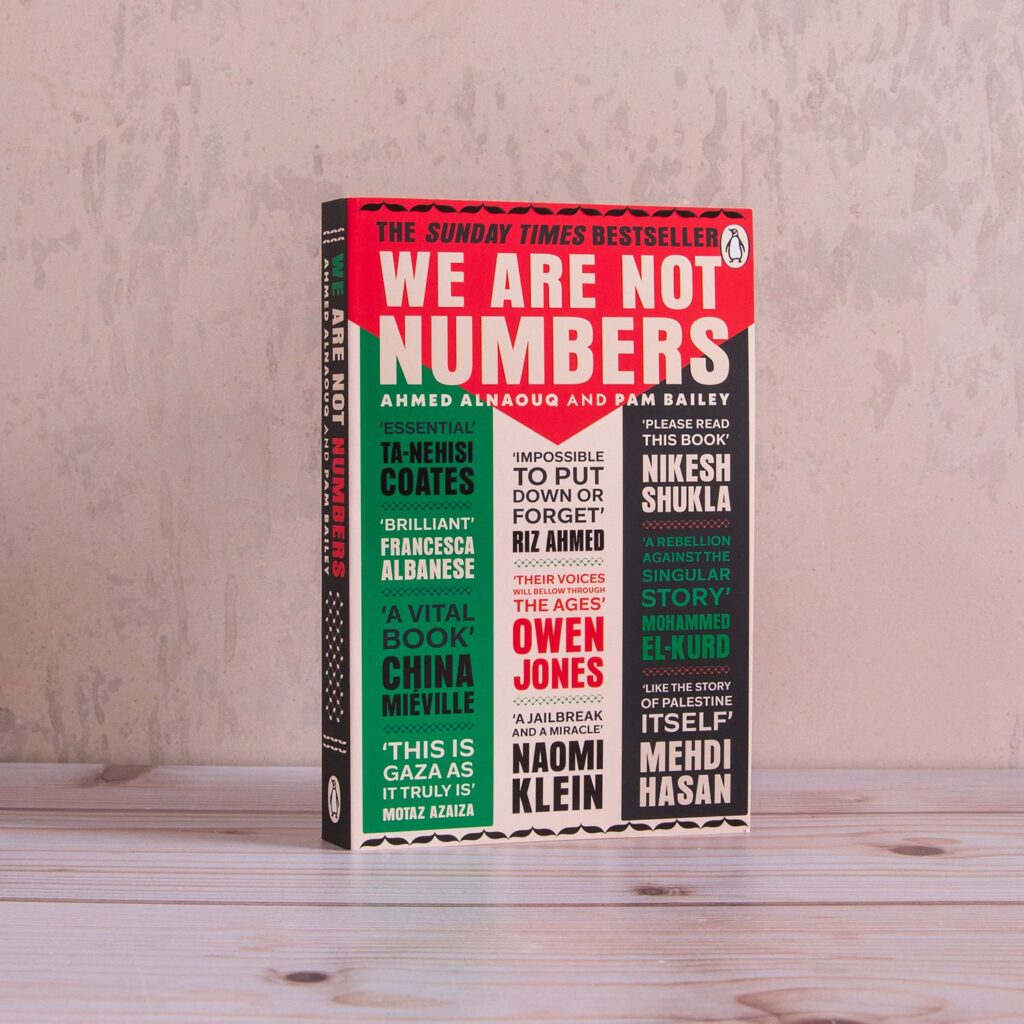
“These are the stories of young people from Gaza, born under Israeli occupation and blockade. They are people who have endured unspeakable struggles and losses, who keep fighting to be recognized not as numbers, but as human beings with hopes, dreams, and lives worth living.”
The Gaza storytelling project, We Are Not Numbers, was founded in 2014 to amplify the voices of Gaza’s youth, from personal reflections and poems to videos. Follow @We_Are_Not_Numbers and read the book.
2. Watch Palestinian films and hold a film screening
Storytelling in film is a powerful vehicle to deepen understanding of Palestinian lived experiences. It’s also an entry point to bring along friends and colleagues who want to learn more, which can spark important conversations and fire them up for taking action.
🎞️ Film recommendations to learn about Palestine
Check out where you can watch the following films:
🍉 Subscribe to Watermelon+
Boycott Disney+ (which is on the BDS list) and invest in Palestinian voices instead. You can subscribe to Watermelon+, an online streaming platform from the Palestinian-owned studio Watermelon Pictures, to watch a variety of films featuring underrepresented voices.
📺 Host your own living room screening
Watch our webinar to learn how you can host your own film screening from your living room. You can use this toolkit made for The Encampments film to plan your gathering, and share action steps relevant to the film you’ll be watching.
American Doctor is now in theaters and at local film screenings. Get a group of friends together to watch the film, and then channel that energy into action by advocating for the freedom of nearly 100 Palestinian healthcare workers in Israeli detention, including Dr. Hussam Abu Safiya.10
3. Look up: How much of your tax dollars fund genocide?
Type your city or state to begin.
In 2025 alone, the U.S. government sent Israel $12 billion in military funding to mass murder Palestinian people. With your federal tax dollars, the Israeli military has been bombing Gaza and wiping out entire families, while lining the pockets of weapons manufacturers who produce these deadly weapons, and the surveillance apparati used to target them, here in the U.S.
Find out how much money people in your city are forced to pay, and what could be funded instead. Look up your location on this interactive map. Read more on the Not My Tax Dollars website run by our sibling organization, USCPR Action, including the methodology.
Want to educate your community? Hold a Not My Tax Dollars teach-in about where our tax dollars go. Use the resources in your activist toolbox from USCPR Action.
4. Honor our martyrs in a vigil

Mourn, pray, and hold space for grief together to honor all of our martyrs killed by Israel. In their memories, you can read out their names, share their stories, or display their photos with candles and tea lights. Close with a strong call-to-action to stop arming Israel.
5. Teach kids about Palestine and support their actions
If you know children who are heartbroken that their Palestinian siblings are suffering, help them turn their anger into action. In Gaza, Palestinian kids called to end the genocide in a press conference outside Al Shifa Hospital on Nov. 7, 2023. Palestinian poet Mosab Abu Toha has called for children’s actions around the world in solidarity.
Mobilize your community in solidarity with Palestinian kids year-round, and especially on the Palestinian Children’s Day of Action on Saturday, Nov. 7, 2026. Support youth organizing, hold a march or vigil, or host a Story Time for Palestine to read aloud Palestinian picture books. You can use these educational resources:
- MECA’s Teach Palestine curriculum
- Palestinian Children’s Day of Action toolkit, including children martyrs signs, children’s activities, and a story time reading list
Plus, drop the ADL from schools: If your school or community uses harmful Zionist materials from anti-Palestinian organizations like the ADL, then take action with this advocacy toolkit from #DropTheADLFromSchools. You can also sign on to this letter to education leaders.
More Resources
For more educational resources, check out Decolonize Palestine for Palestine 101 history including a detailed reading list.
BACK: Go to the Stop Gaza Genocide toolkit.
This toolkit is intended to be a 501(c)3 compliant resource. It is not intended to advocate for unlawful activities.
Footnotes
- https://www.aljazeera.com/gallery/2025/5/15/one-long-nakba-palestinians-mark-77-years-since-mass-expulsion-by-israel
- https://www.aljazeera.com/news/2025/8/11/here-are-the-names-of-the-journalists-israel-killed-in-gaza
- https://www.middleeasteye.net/live-blog/live-blog-update/israel-boosts-propaganda-funding-150-million-sway-global-opinion-against
- https://www.middleeasteye.net/news/israel-paying-us-influencers-reverse-negative-public-opinion-report
- https://scholar.smu.edu/cgi/viewcontent.cgi?article=1056&context=thedialogue
- https://gulfnews.com/opinion/op-eds/hollywoods-troubling-depiction-of-arabs-1.101313507
- https://theconversation.com/bias-hiding-in-plain-sight-decades-of-analyses-suggest-us-media-skews-anti-palestinian-216967
- https://www.btselem.org/statistics/detainees_and_prisoners
- https://zeteo.com/p/israel-has-kidnapped-another-american
- https://www.aljazeera.com/news/2025/10/22/who-are-the-95-palestinian-healthcare-workers-held-captive-by-israel